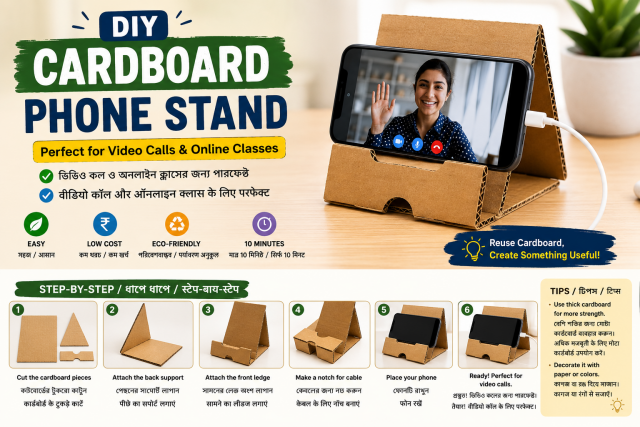
Quick answer: A useful phone stand needs a wide base, a low centre of gravity, a front lip that does not cover the screen, and a back support that keeps the phone at a comfortable angle. This version uses ordinary corrugated cardboard and tape, with no electrical work or permanent change to the phone.
Affiliate disclosure: This article may contain affiliate links. If you buy through them, JoLLy KA Tech may earn a commission at no extra cost to you. Product suggestions are based on suitability, safety, warranty and value—not commission. As an Amazon Associate I earn from qualifying purchases.
সহজ কথায়: কার্ডবোর্ড দিয়ে এমন একটি ফোন স্ট্যান্ড বানান যাতে ফোনটি স্থির থাকে, চার্জিং পোর্ট বন্ধ না হয় এবং ভিডিও কলের সময় সহজে দেখা যায়।
आसान भाषा में: कार्डबोर्ड से ऐसा फोन स्टैंड बनाएं जो स्थिर रहे, चार्जिंग पोर्ट न ढके और वीडियो कॉल में सही कोण दे।
Project time: 15–25 minutes • Difficulty: Beginner • Best for: Video calls, recipes, online classes and desk viewing
What this project can—and cannot—do
This stand can hold a normal phone in portrait or landscape orientation on a flat desk. It is not intended for a tablet, a very heavy rugged phone, a moving vehicle, a bed or any surface where the phone could fall onto someone. A homemade stand also cannot replace a certified vehicle mount.
Materials you probably already have
- A piece of clean corrugated cardboard, roughly the size of an A4 sheet
- A ruler and pencil
- Strong paper tape or wide transparent tape
- Scissors suitable for cardboard; an adult should handle cutting for children
- Two small pieces of rubber shelf liner, an old mouse-pad offcut or removable anti-slip tape
- Optional: coloured paper, non-toxic glue and a label for decoration
Do not place a charging phone inside a closed cardboard pocket or cover its ventilation area. Keep the charger, cable and phone visible and able to release heat.
Choose the right size before cutting
Measure the phone while its normal case is fitted. Add a little clearance so the stand does not squeeze side buttons. The front lip usually needs to be high enough to stop sliding but low enough to avoid blocking gestures, speakers or the lower part of the display.
- Base: about one and a half times the phone width
- Back support: slightly shorter than the phone height
- Front lip: around the height of a fingertip, adjusted for your phone
- Viewing angle: start near 60 degrees, then test before taping permanently
Step-by-step build
- Cut one rectangular base and one back-support piece. Round sharp cardboard corners with scissors.
- Fold a narrow strip at the bottom of the back support. This folded strip will attach to the base.
- Place the phone on the base and lean the back support behind it. Move the support until the screen is comfortable to view without the stand tipping.
- Tape the folded strip firmly to the base on both sides. Add a triangular cardboard brace behind the support if it flexes.
- Make a small front lip from a folded cardboard strip and tape it to the base. Leave a centre gap if you want to connect a charging cable.
- Add anti-slip pieces under the base. Test portrait and landscape positions using one hand close to the phone in case it falls.
- Decorate only after the stand passes the stability test. Keep paint, wet glue and loose glitter away from the phone.
The five-second stability test
- Tap the upper left and upper right corners of the screen gently.
- Swipe upward and sideways as you normally would.
- Insert and remove the charging cable without pulling the stand forward.
- Rotate the phone to landscape mode.
- Move the desk slightly. If the stand rocks, widen the base or add a rear brace.
Make it easier for older family members
Write “FRONT” on the base, mark the charging-cable gap, and add a bright strip where the phone should rest. A familiar fixed position is often more helpful than a stand with many adjustments.
Optional products that fit naturally in this guide
Useful affiliate opportunities include an adjustable phone stand, anti-slip pads, hook-and-loop cable ties, a desk mat or a compact Bluetooth remote for group photos. Recommend only products that solve a real limitation of the cardboard version, and state why someone may not need to buy them.
When to buy a proper stand instead
- The phone is unusually heavy or has a folding design
- You need frequent angle or height adjustment
- You type on the phone while it is mounted
- You need a secure vehicle, bicycle or kitchen-wall mount
- The homemade stand becomes soft, wet, bent or unstable
Frequently asked questions
Can I use a shoebox instead of flat cardboard?
Yes. A clean, dry shoebox can provide stronger corrugated pieces. Avoid cardboard that smells damp, has mould or has held chemicals.
Will this work while charging?
It can, provided the cable has a clear path, the phone and charger remain ventilated, and nothing bends the connector. Stop if the plug becomes loose or unusually hot.
Can children make it?
Children can measure, fold and decorate, but an adult should supervise cutting and test the finished stand for sharp edges and stability.
Is landscape mode stable?
It can be more stable because the phone is lower, but only when the front lip supports the phone without pressing buttons. Test both orientations.
Sources and further reading
Important: Device designs, app menus and manufacturer instructions can change. Check the manual for your exact device before using cleaners, stands, chargers, storage products or accessories.