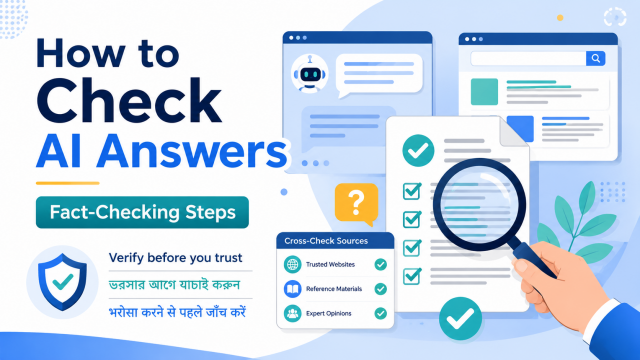
Quick answer: Never judge an AI answer only by how confident or detailed it sounds. Separate facts from suggestions, check the date, open original sources, confirm names and numbers, and use an official or qualified source for important decisions.
Affiliate disclosure: This guide may contain affiliate links. If you buy through them, JoLLy KA Tech may earn a commission at no extra cost to you. Any product suggestion should be based on compatibility, safety, warranty and value—not commission. As an Amazon Associate I earn from qualifying purchases.
সহজ কথা: AI-এর উত্তর সুন্দর শোনালেই সত্যি নয়—তারিখ, উৎস ও গুরুত্বপূর্ণ তথ্য আলাদা করে যাচাই করুন। सरल बात: आत्मविश्वास से लिखा उत्तर भी गलत हो सकता है; तारीख और मूल स्रोत जाँचें।
Why AI answers can sound correct when they are wrong
AI chatbots predict useful language from patterns and context. They can explain difficult topics clearly, but they can also combine real information with a wrong date, invented quotation, outdated rule or mismatched product specification. This is often called a hallucination.
The risk is easy to miss because the answer may have headings, examples and a confident tone. A chatbot does not become a verified source simply because it writes professionally.
Use the STOP-CHECK method
- S — Separate: Mark statements that are facts, opinions, calculations, predictions or suggestions.
- T — Time: Ask when the information was true and whether it may have changed.
- O — Original source: Prefer the manufacturer, government department, standards body, research paper or service provider over a copied summary.
- P — Precise details: Check names, dates, model numbers, units, prices, quotations and links.
- C — Compare: Look for at least one independent reliable source when the decision matters.
- H — High-stakes caution: Use qualified medical, legal, financial, electrical or safety help where appropriate.
- E — Evidence: Confirm that each citation actually supports the sentence beside it.
- C — Current location and version: Rules and menus can vary by country, state, app version, device and account.
- K — Keep uncertainty: If reliable sources disagree or information is missing, say so instead of forcing a confident conclusion.
10 simple fact-checking steps
- Ask for the key claims only. Prompt: “List the five factual claims in your answer that I should verify.” This turns a long response into a manageable checklist.
- Ask what may be outdated. Prompt: “Which parts depend on current prices, laws, software versions, schedules or product availability?”
- Request sources, then open them. A link is not proof until you check the page, publisher, date and relevant section.
- Prefer primary sources. For a phone specification, use the manufacturer page or manual. For a government scheme, use the responsible government portal. For a research claim, look for the actual paper.
- Check whether the source says the same thing. Sometimes a cited page is related to the topic but does not support the exact number or conclusion.
- Verify dates and geography. A rule for another country, an old app interface or a discontinued product can look relevant while being unusable for you.
- Recalculate important numbers. Check units, percentages, tax, storage conversion, battery estimates and totals with a calculator or spreadsheet.
- Search the exact phrase. Put a suspicious quotation, error message or unusual statistic inside quotation marks. No trustworthy result is a warning sign, not automatic proof of falsehood.
- Ask a second tool a neutral question. Do not tell it what the first chatbot said. Independent wording reduces the chance of repeating the same framing.
- Keep a “not verified” label. When evidence is incomplete, do not publish or forward the claim as fact.
A source-quality ladder for beginners
Use the highest practical level available:
- Primary and official: official manuals, government portals, standards organisations, original research, service-status pages and the company’s own support documentation.
- Strong independent sources: established technical publications, consumer organisations, universities and reputable newsrooms with transparent corrections.
- Useful but limited: retailer listings, user forums, community posts and videos. These may reveal real-world problems but can be incomplete, sponsored, outdated or wrong.
- Weak evidence: anonymous screenshots, copied social posts, AI-generated summaries with no sources, and websites that make strong claims without an author, date or references.
Official does not always mean unbiased. A manufacturer is usually reliable for port type or warranty wording, but an independent test may be better for heat, battery life or long-term behaviour. Match the source to the claim.
How to verify five common AI tasks
1. Product comparison
- Match the exact model number, storage size and regional variant.
- Check the official specifications and warranty terms.
- Treat retailer titles as marketing, not a complete specification sheet.
- Confirm what is included in the box and whether an accessory is required.
- Check the current seller, return window and service availability before purchase.
For storage devices, this pen-drive buying guide shows why connector labels and advertised capacity need context.
2. Phone or computer troubleshooting
- Copy the exact error message rather than describing it from memory.
- Confirm device model, operating-system version and recent changes.
- Start with reversible steps such as restart, cable check, storage check and official updates.
- Do not run copied commands you do not understand.
- Back up important data before resets, firmware changes or storage repairs.
3. News and current events
- Check the publication date and the date the event actually occurred.
- Look for multiple reputable reports and an original announcement or record.
- Separate confirmed events from analysis, rumours and predictions.
- Be cautious with screenshots that omit the account name, time or surrounding context.
4. Health, law or money
Use the chatbot to prepare questions, explain general terms or organise information—not to replace a qualified professional. Confirm dosage, diagnosis, legal deadlines, eligibility, tax treatment, interest rates and investment risk with the appropriate professional or authority.
5. Translation
- Identify whether the text is casual, legal, medical, technical or ceremonial.
- Ask the chatbot to preserve names, dates and numbers exactly.
- Have a fluent speaker review sensitive or public-facing text.
- Do not assume a translated warning, consent form or contract keeps the exact legal meaning.
Prompts that make verification easier
Review your previous answer as a fact-checker.
1. List each claim that could be checked.
2. Mark it as stable, time-sensitive, uncertain or opinion.
3. Give the best type of original source for each claim.
4. Do not invent a citation.
5. Say “I could not verify this” when evidence is missing.
Search for current information and cite primary sources.
My country/region is [LOCATION].
The exact product/service/version is [DETAILS].
Separate confirmed facts from assumptions.
Include the date each time-sensitive fact was checked.
Use only the document I pasted below.
Quote no more than one short sentence at a time.
For every conclusion, identify the section that supports it.
If the document does not answer the question, say so clearly.
Warning signs in an AI-generated answer
- A precise statistic with no source or date.
- A quotation that cannot be found on the named page.
- A link whose title is relevant but whose content says something different.
- A product feature that belongs to another model or country variant.
- A government rule with no department, notification number or effective date.
- A claim that “everyone,” “always” or “never” applies without exceptions.
- A medical, legal or financial instruction written as a guarantee.
- A calculation that mixes units, tax periods or percentages.
- Several sources that all copy the same original mistake.
Before publishing AI-assisted content
- Rewrite and edit it in your own editorial voice.
- Verify every meaningful factual claim and link.
- Remove invented testing language such as “we tested” unless you actually tested it.
- Check whether examples contain private, copyrighted or confidential material.
- Add limitations, dates and regional differences.
- Use descriptive headings instead of keyword repetition.
- Keep a record of important sources for future updates.
This matches JoLLy KA Tech’s editorial approach: researched guidance should not be presented as personal hands-on testing, and changing prices, models and policies should be clearly acknowledged.
Frequently asked questions
Can asking the AI to “be accurate” prevent errors?
No. It can encourage caution, but it cannot guarantee correctness. Verification requires checking reliable evidence outside the generated answer.
Are citations generated by AI always real?
No. A citation may be wrong, incomplete, outdated or unrelated. Open the source and confirm that it supports the exact statement.
Is a second chatbot enough to verify the first?
Not by itself. Different systems may repeat the same widely copied error. Use original or authoritative sources whenever possible.
Should I trust an answer that includes many details?
Detail can be useful, but it is not proof. More details create more facts to check, especially names, dates, measurements and quotations.
What should I do when sources disagree?
Check whether they cover different dates, regions, models or definitions. Prefer better evidence, explain the disagreement and avoid a stronger conclusion than the sources support.
Official references
- OpenAI: What is ChatGPT? (includes limitations)
- Google: Learn about responses from Gemini Apps
- Anthropic: Incorrect or misleading Claude responses
- Anthropic: Web search and verification guidance
Last reviewed: 27 July 2026. AI tools, menus, limits and privacy settings can change. Check the provider’s current help pages before relying on a feature or setting.